
- by Liam Hoffman
Why We Use Hickory For Handles
- by Liam Hoffman

Two qualities I look for in an axe handle are its ability to take a hit and its ability to flex. Hickory gives us a sweet combination of the two, which is why it’s our first choice at the Hoffman shop.
Does the hardest wood make the best axe handle? Far from it! The Janka chart below tells us how well a wood resists dents. It doesn’t tell us how well a finished handle will take repeated blows. Hardness, bending strength, and stiffness are different things, and we need to look at more than one number.

Chart courtesy of www.customcountrywoods.com
We use kiln-dried hickory for its combination of toughness, hardness, and availability. We’re fortunate to be located in hickory country here in East Tennessee.
Of course, “hickory” doesn’t mean every piece of wood is the same. There are different species, and even two trees of the same species can produce different wood. Picking the species is a good start; the piece you’re working with still matters.
Ash makes a good tool handle too. White ash is known for toughness and shock resistance. Hickory is our preference for its ability to stand up to impact and the supply we have here.
Weight is one difference. In USDA tests of clear wood at 12% moisture content, shagbark hickory was denser and had higher impact-bending values than white ash. That can mean a lighter handle from white ash at the same dimensions. These are averages for those two species, though. They don’t tell us how every hickory or ash handle will hold up.
Whichever wood you choose, look at the piece in your hands and the shape of the handle as well as the species name.
For the numbers behind this comparison, see the USDA Wood Handbook, Chapter 5, Tables 5–3a and 5–3b.
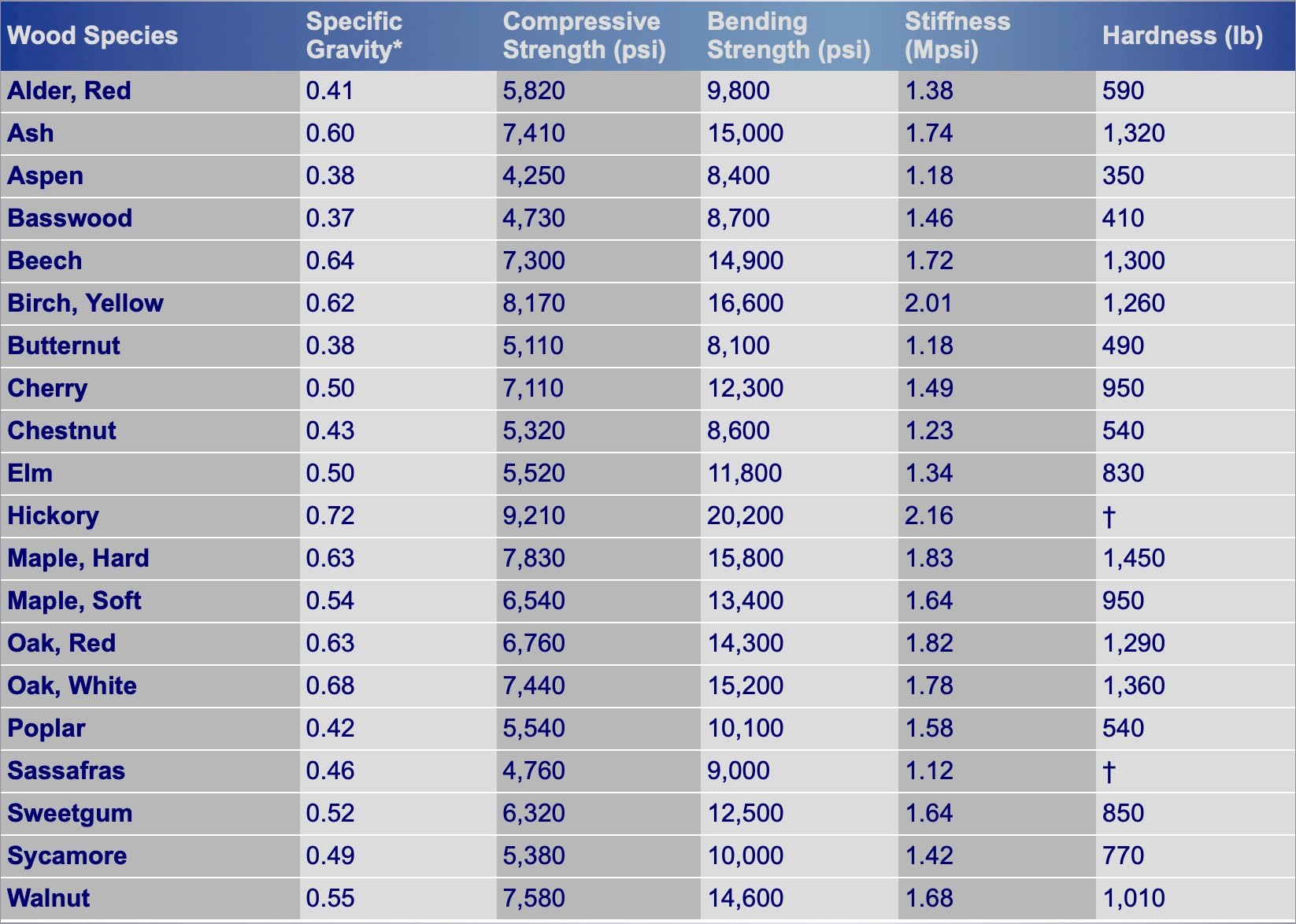
This chart compares hardness and bending strength in different North American woods. It helps show why I look at more than hardness when choosing handle wood.
Hickory is our regular choice, but it isn’t the only good wood for an axe handle. Osage orange and purpleheart make great handles too. We offer them from time to time as we can get the material. Take a look at our Osage Orange Handles and Purple Heart Handles to see the options.
Keep in mind that the chart doesn’t tell us about the grain, condition, or shape of a particular handle. Choosing the best wood for an axe handle takes more than finding the highest number on a chart.
Chart courtesy of www.workshopcompanion.com
Wood species plays a big role in whether your handle holds up, but it’s not the end all. The geometry and length contribute a lot too. The longer the handle, the more demanding it will be on the wood. This means some unconventional woods can work just fine on shorter handles.
Ironically, in my experience, a handle that’s too thick can actually be weaker in use than a thinner handle shaped to flex with the blow. Extra thickness makes it more rigid. A properly shaped handle can flex and spring back to shape. That doesn’t mean taking off as much wood as possible—the thickness, length, and wood all have to work together.
The transitional curves matter too. I’m talking about how the eye flows into the shoulder and down into the midsection. An abrupt shoulder, sharp corner, or tight radius can create a stress point and increase the chances of a break. We want the shape to flow.
Thickness also changes how the axe feels when you swing it and the wear and tear on your body. There’s a lot more to axe handle geometry than we can cover here, so I’ll dig into the thickness, curves, and transitions in a future article.
Look at the wood itself, too. Knots and fibers that run across the handle can affect strength. The direction the fibers run is different from the growth-ring pattern on the end.
For a replacement handle, compare your axe head’s eye measurements with the dimensions on the product page. The handle usually needs shaping to fit that individual head. Our How To Hang An Axe guide walks through fitting and hanging with written instructions and a video.
Kiln-dried doesn’t mean the wood will stay at the same moisture level forever. It can still pick up moisture and dry out again. A finish can slow that down, but an oiled handle isn’t waterproof. Keep your axe dry when you’re done with it.
If you’d like us to oil your handle before it leaves the shop, add our handle oiling service to your order. We’ll soak it in boiled linseed oil before shipping. Add one oiling service for each handle.
More on this in the USDA Wood Handbook, Chapter 13: Drying and Control of Moisture Content and Dimensional Changes.
If you’re replacing an old handle, you can browse our axe and hatchet handles and check the dimensions against your head before you choose.
Making your own handle? Take a look at our handle billets.
Share:
How To Hang An Axe
Octagonal VS Oval Handles